
Travelers: A Field Guide to Location-Based Play
Travelers is being built as a real-world exploration game where the map is more than a menu. Locations can become relic sites, loot caches, stores, upgrade points, events, or traces of earlier encounters. The goal is to reward curiosity while keeping location use understandable, testable, and respectful of the places people actually visit.
Open Travelers Navigation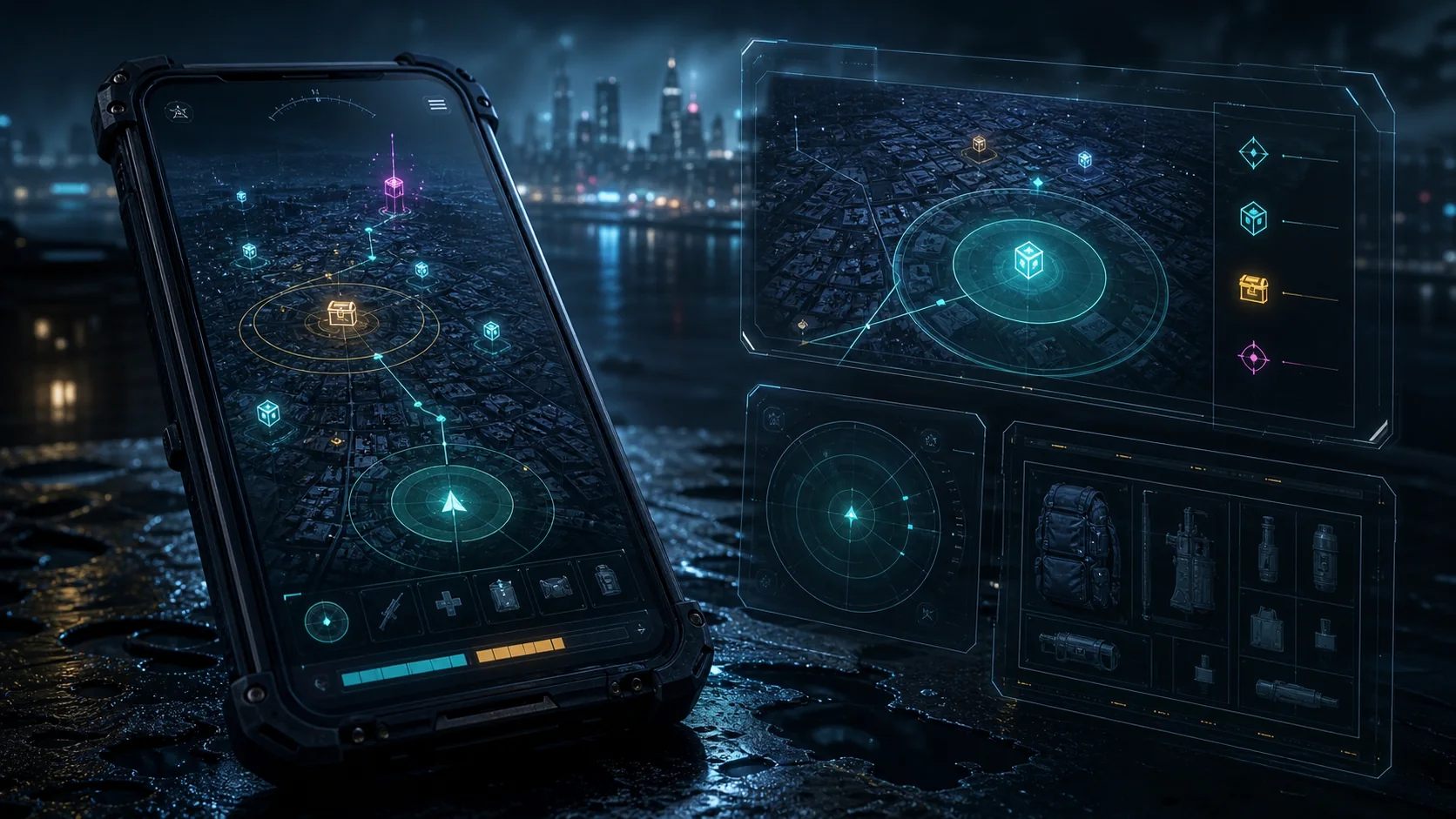
The exploration loop
A player begins by granting location access, centering the map, and reviewing nearby signals. A marker represents a type of opportunity rather than a generic dot. Relics support collection, loot chests support discovery, stores can support trading or upgrading, and event markers can temporarily reshape an area. A legend makes these differences visible before the player travels.
When a player approaches a valid site, the game can reveal additional actions. A camera view may place a semi-transparent object into the scene for an augmented discovery moment. The standard map and interaction controls remain available for devices that cannot or should not use the camera.
From location files to living game zones
Large CSV imports make it possible to seed geographic coverage without placing every marker by hand. Coordinates are only the beginning. Each imported row can receive a role, rarity, availability window, event relationship, and administrative status. An administrator can also place a test object directly on the map and reassign what an existing location represents.
A dense national dataset should not produce fifty thousand markers at once. Travelers loads content around the current map area and zoom level, clusters distant objects, and returns more detail as the player approaches. This protects performance and makes the map readable.
Loot, equipment, and encounter traces
Loot is designed around a backpack rather than an endless list. Weapons, armor, consumables, and relics need understandable capacity, condition, and upgrade paths. Medium-level chests can be common enough to sustain exploration while rarer rewards remain tied to events, longer routes, or carefully managed locations.
A completed encounter can leave a temporary trace such as damaged equipment, a recovered item, or a historical marker. These traces create a sense that the world has memory. Retention limits and privacy rules are important: a battle history should enrich the game without exposing a person’s private movement history.
Safety and real-world responsibility
The safest location is not necessarily the most interesting coordinate. Locations should be screened for public access, operating hours, traffic risk, restricted property, emergency facilities, schools, and other sensitive settings. Administrators need a quick way to disable a location, and players need a visible reporting path.
Travelers should never encourage play while driving or require trespassing. Location accuracy varies by device and environment, so interaction radiuses need reasonable tolerance. The game can be dramatic without turning uncertainty into pressure.
Useful answers before you begin.
Why do all imported locations not appear at once?
The map should request objects near the visible map bounds, cluster distant items, and reveal more detail at closer zoom levels. Loading every national location simultaneously would reduce clarity and performance.
Will the camera be required?
No. Camera overlays can add an optional discovery moment, while the map and accessible interaction controls remain the dependable path.
Can a business become a game location?
The planned location program can support approved trading, upgrade, event, or sponsored destinations. Placement must remain transparent, safe, and subject to administrative review rather than guaranteeing visits or sales.